Leave Your Message
Stone Painting can refresh a stone façade, garden wall, fireplace, or interior feature without replacing the material beneath it. The right coating can unify mismatched repairs and add color where bare stone looks tired. But it is not a universal fix. A sealed surface may trap moisture, while poor preparation can leave paint peeling around edges and mortar joints.
The market is growing, though the available figures require careful reading. Grand View Research estimated the global paints and coatings market at USD 190.1 billion in 2023, with projected annual growth of 4.3% from 2024 to 2030. This covers many coating applications; it does not measure Stone Painting specifically. Treat it as industry context, not proof that every stone surface benefits from paint.
Architectural critic John Ruskin wrote, “The greatest glory of a building is not in its stones, nor in its gold. Its glory is in its Age.” His words offer a useful caution: coating stone changes how its surface and age are seen. That tension deserves a pause. Before choosing a finish, identify the stone, check for moisture, and test a small, inconspicuous area. A sample patch beside an old mortar joint can reveal more than a color chart. The result may look striking, but reversibility and long-term maintenance still matter. Stone Painting is most successful when the project respects both the desired appearance and the material’s limits.
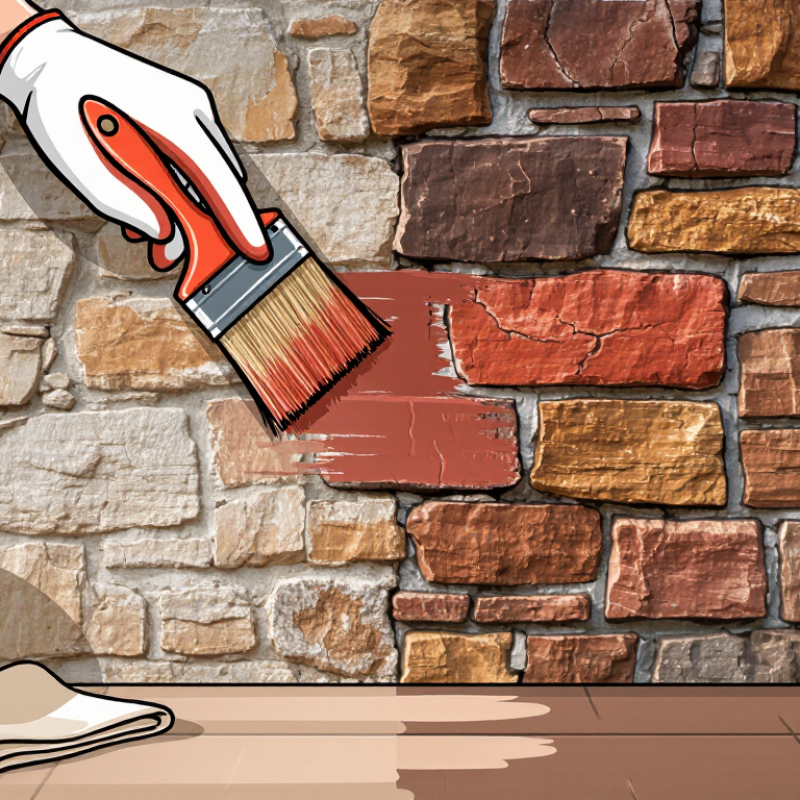
Stone painting means applying a compatible coating to a mineral surface such as limestone, sandstone, or granite. These stones differ in texture and porosity. A dusty limestone wall may absorb water quickly, while dense granite can resist it. The difference matters. Paint that suits one surface may peel or trap moisture on another.
ASTM C97/C97M measures water absorption and bulk specific gravity in dimension stone. Absorption results help describe how much water a stone takes in under the test conditions. They can inform coating choices, but they do not predict paint performance by themselves. Check the stone’s condition, existing sealers, and moisture exposure too. A small test patch often reveals uneven color or poor adhesion. One test rarely tells the whole story.
Tips: Ask for the stone’s C97 absorption data when available. Clean a sample area, let it dry, then test the intended coating. Watch for dark patches, flaking, or slow drying. Results can be imperfect; site conditions may differ from the lab.
| Stone substrate | Common mineral composition | Porosity and absorption considerations | What ASTM C97/C97M contributes | Practical coating considerations |
|---|---|---|---|---|
| Granite | Typically composed mainly of quartz and feldspar, with varying amounts of other minerals. | Absorption varies with mineral makeup, grain boundaries, weathering, and existing cracks; the stone name alone does not establish an absorption value. | Provides laboratory methods for determining water absorption and bulk specific gravity of dimension stone specimens. | Assess the actual surface condition and coating-system requirements. A test result can inform evaluation but does not by itself establish paint adhesion or suitability. |
| Limestone | Composed predominantly of calcite; some varieties also contain dolomite, clay, or other minerals. | Absorption can differ substantially among varieties and may be affected by pore structure, bedding, and weathering. | Can help quantify water absorption for representative stone specimens; results should be linked to the sampled stone and reported test method. | Check for moisture, salts, surface degradation, and compatibility with the proposed coating before application. |
| Marble | Metamorphic rock composed primarily of recrystallized calcite or dolomite. | Absorption is stone-specific and can vary with crystal structure, veins, fissures, and finish. | Offers a standardized way to measure absorption and bulk specific gravity rather than relying on visual appearance alone. | Confirm that preparation and coating products are appropriate for the particular stone and its polished, honed, or weathered finish. |
| Sandstone | Clastic rock made mainly of sand-sized grains, commonly quartz, held together by a mineral or other cement. | Pore volume and connectivity depend on grain size, sorting, cement, and condition; absorption therefore varies by source and specimen. | Absorption data can support material characterization and comparison when specimens are tested and documented consistently. | Evaluate surface cohesion and moisture movement. Weak or friable areas may require attention before a coating is considered. |
| Slate | Fine-grained metamorphic rock, commonly containing quartz, mica, and other minerals, with a characteristic planar cleavage. | Absorption and water movement can differ between stone types and may be influenced by cleavage planes, defects, and weathering. | Measures absorption and bulk specific gravity of dimension stone specimens; it is not a direct coating-adhesion test. | Inspect cleavage, edges, and existing surface treatments, and verify coating compatibility on the specific substrate. |
| Natural stone, any type | Mineral composition and texture vary by geological origin, quarry, and individual stone. | Do not assume a single absorption value for an entire stone category. Representative sampling and clear reporting are important. | ASTM C97/C97M covers test methods for absorption and bulk specific gravity of dimension stone. It does not specify a universal acceptance limit for painting. | Use absorption results alongside substrate inspection, moisture assessment, coating-system guidance, and project-specific test patches. |
Note: ASTM C97/C97M absorption results describe water absorption under the specified test method. They do not independently predict paint adhesion, durability, vapor transmission, or overall coating performance. Consult the applicable edition of the standard and report the tested specimen and conditions.