Choosing the right Silicone Repair Glue is not simply a matter of buying the strongest tube. The correct product must match the silicone surface, repair location, movement, temperature, and moisture exposure. A bathroom seal, flexible appliance gasket, and outdoor rubber component face very different stresses. The wrong adhesive may look secure today, then peel after repeated bending or cleaning.
Industry data shows why this decision matters. Grand View Research’s Silicone Sealants Market Size, Share & Trends Analysis Report identifies construction, automotive, and industrial applications as major demand areas. These sectors commonly require durable sealing, flexibility, and resistance to water or temperature changes. MarketsandMarkets’ Silicone Elastomers Market report also highlights silicone’s use in transportation, healthcare, electronics, and consumer products. However, silicone remains difficult to bond because its low surface energy limits adhesion. That technical detail is often overlooked.
A practical selection process should examine curing chemistry, elasticity, service temperature, chemical resistance, and application method. Product technical data sheets should provide tensile strength, elongation, cure time, and recommended substrates. Independent standards from ASTM International can also help buyers judge testing methods, although test results may not perfectly represent household repairs. That is worth remembering. A glue tested on clean laboratory silicone may perform differently on dusty, aged, or oily material.
This guide explains how to compare Silicone Repair Glue with realistic repair conditions. It considers surface preparation, joint movement, indoor and outdoor exposure, and long-term reliability. No adhesive is perfect. A careful choice, combined with proper preparation, usually matters more than a bold strength claim.
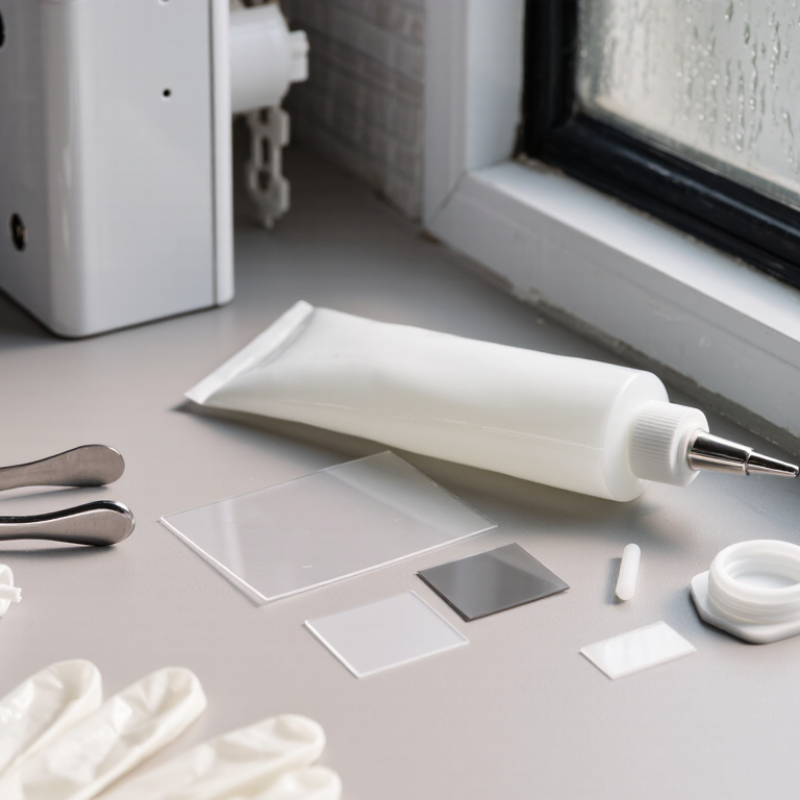
Silicone repair glue is usually a flexible silicone adhesive or sealant. It often uses room-temperature vulcanizing chemistry. Moisture in the air triggers cross-linking, changing the liquid material into a rubbery solid. This bond can resist water, vibration, and temperature changes. It is useful for cracked gaskets, flexible tubing, bathroom joints, and small appliance seals.
Market data shows its industrial importance. Grand View Research estimated the global silicone sealants market at about US$5.8 billion in 2023. Fortune Business Insights reported a similar value, near US$6.0 billion, although both reports use different market definitions. That difference matters. Market figures are estimates, not laboratory facts. Repair performance depends more on surface condition than market size.
Before applying the glue, remove grease, dust, and loose silicone. A dry, lightly roughened surface usually improves contact. Apply a thin, continuous bead. Thick layers may cure slowly inside. Many products form a skin within minutes but need 24 to 72 hours for deeper curing. Check the technical data sheet. Not magic.
Silicone bonds well to glass, ceramic, and many plastics, but poorly to some metals and low-energy plastics. It also has limited strength under constant pulling or peeling. I would not use it for safety-critical structures. A repair may look perfect while hiding weak adhesion underneath. Testing a small area first is the careful choice.
Silicone repair glue works best with silicone rubber and many smooth, non-porous surfaces. It can bond glass, ceramic, glazed tile, and some metals, including aluminum and stainless steel. These materials often appear in bathroom seals, kitchen fixtures, window frames, and flexible household parts. The cured adhesive stays elastic, so it can handle slight movement, vibration, and changes in temperature.
Dust, grease, soap residue, and moisture can weaken the bond. Wipe the surface with a suitable cleaner, then allow it to dry completely. Lightly roughening smooth metal may improve grip, but glass usually needs careful cleaning instead. Press the parts together evenly. Too much glue can slow curing and create a weak center.
Polyethylene, polypropylene, and PTFE are difficult surfaces for ordinary silicone repair glue. Their low surface energy prevents reliable adhesion. Soft rubber can also behave unpredictably, especially if it contains oils or plasticizers. A small test patch often reveals more than product descriptions. In practical repairs, the surface may look clean but still fail because of invisible residue. I have found that curing time is easy to underestimate. A repair can feel firm outside while remaining soft underneath. Check the instructions, allow full curing, and avoid stressing the joint too early.
Choosing silicone repair glue requires comparing the formula, not only the tube label. One-part RTV formulas cure with moisture and suit small household repairs. Two-part systems cure faster and provide more controlled bonding. Acetoxy silicone often releases a vinegar-like odor during curing. Neutral-cure silicone is usually safer around metal, glass, and sensitive surfaces. The gap matters.
Surface preparation decides much of the result. Remove oil, dust, and loose silicone before application. A clean, dry surface improves wetting and reduces early peeling. Check the technical data sheet for temperature limits, skin time, full-cure time, and elongation. ASTM C920 is a useful reference for silicone sealant performance, although not every repair glue carries this classification. Do not assume flexibility equals strength. A flexible bead may still fail under constant tension.
Market data also provides context. Grand View Research estimated the global silicone sealants market at approximately US$5.1 billion in 2023, with continued growth expected through 2030. Reports from different research firms vary because their product categories differ. That uncertainty deserves attention. I would compare technical test results before trusting market claims. Look for adhesion data on your actual material, such as ceramic, aluminum, rubber, or painted plastic. Test a small hidden area first. It may feel excessive. In practice, compatibility failures often appear only after heat, moisture, or repeated movement. A repair that looks perfect overnight may separate after a week.
| Silicone Repair Glue Type | Curing Chemistry | Typical Cure Profile | Adhesion and Flexibility | Water and Weather Resistance | Typical Temperature Range* | Best Repair Applications | Important Limitations |
|---|---|---|---|---|---|---|---|
| Acetoxy-Cure RTV Silicone | Releases acetic acid while curing; moisture-cured, one-part formula. | Skin usually forms in minutes; full cure commonly takes about 24 hours per 3 mm, depending on humidity and joint conditions. | Very flexible after curing; bonds well to glass, glazed ceramic, and many non-porous surfaces. | Generally excellent after full cure; suitable for many indoor and outdoor sealing repairs. | Often approximately −50°C to 180°C; verify the product technical data sheet. | Glass joints, ceramic items, bathroom seals, aquarium-related sealing when specifically approved, and general non-porous repairs. | Acidic vapors can corrode some metals and may affect alkaline or cement-based surfaces; poor choice for sensitive substrates. |
| Neutral-Cure Oxime Silicone | Moisture-cured neutral system, commonly releasing oxime by-products. | Usually skins in roughly 10–30 minutes; full cure is commonly around 24 hours per several millimetres. | Good elastic recovery and broad adhesion to metals, plastics, glass, painted surfaces, and masonry when properly prepared. | Very good resistance to rain, humidity, and ultraviolet exposure after curing. | Commonly approximately −50°C to 150°C or higher, depending on formulation. | Automotive trim, metal housings, exterior joints, appliances, plastics, and mixed-substrate repairs. | Some formulas release an odor during cure; adhesion to low-energy plastics may require testing or a primer. |
| Neutral-Cure Alkoxy Silicone | Moisture-cured neutral system, commonly releasing alcohol during cure. | Low-odor curing; skin formation and full cure depend strongly on humidity, bead thickness, and ventilation. | Flexible and suitable for many porous and non-porous materials; often selected where low corrosion is important. | Good long-term resistance to moisture, weathering, and ultraviolet exposure in exterior-grade formulas. | Frequently around −40°C to 150°C; the stated rating varies by product. | Sensitive metal assemblies, windows, building joints, plastics, painted surfaces, and low-odor indoor repairs. | May cure more slowly in dry conditions; not every formula is suitable for continuous immersion, structural bonding, or food contact. |
| High-Strength Silicone Adhesive-Sealant | Usually a formulated RTV silicone with adhesion promoters and reinforcing fillers. | One-part moisture cure; handling strength develops before full cure, which commonly requires about 24–72 hours. | Higher adhesion and tear resistance than basic sealants while retaining silicone-like flexibility. | Typically excellent for outdoor exposure, vibration, and repeated wetting when the joint is correctly designed. | Often approximately −50°C to 200°C; always use the specified service rating. | Flexible parts, vehicle components, equipment housings, vibration-prone joints, and bonding combined with sealing. | Not a replacement for mechanical fasteners in load-bearing structures; thick sections cure slowly and may need temporary support. |
| Two-Part Silicone Adhesive | Resin and catalyst are mixed before use; cures throughout the mixed material rather than relying only on surface moisture. | Working time may range from several minutes to several hours; full cure is commonly achieved within hours to a few days. | Consistent deep-cure performance, strong elastic bond, and good resistance to vibration and thermal movement. | Very good when fully cured; suitable for demanding environments if the formula is rated for immersion or outdoor use. | Commonly approximately −50°C to 200°C, with specialized grades extending beyond this range. | Thicker repairs, encapsulation, industrial components, controlled production work, and applications requiring reliable deep curing. | Requires accurate mixing, has limited working time, costs more, and is less convenient for quick household repairs. |
| High-Temperature Silicone Repair Compound | Heat-resistant RTV silicone, commonly supplied as a one-part moisture-cured formula. | Usually cures at room temperature; some applications require a staged heat-up after the initial cure. | Flexible and resistant to thermal cycling, but bond strength depends on surface preparation and joint design. | Good resistance to heat, oil, and moisture only when the specific formula is rated for those conditions. | Commonly rated around −50°C to 250°C; specialized products may have higher intermittent ratings. | Oven gaskets, engine-area components, heating equipment, exhaust-adjacent seals, and high-heat appliance repairs. | Not all high-temperature formulas are fuel-resistant or suitable for direct flame; avoid use beyond the published rating. |
| Self-Fusing Silicone Repair Tape | Uncured silicone tape fuses to itself when stretched and wrapped; it does not normally bond like a liquid adhesive. | Forms a tight, cohesive wrap immediately; performance improves as the layers conform and fuse. | Excellent flexibility and elongation; useful for irregular shapes and temporary or emergency repairs. | Very good resistance to water, weather, and many electrical environments when correctly overlapped. | Often approximately −50°C to 180°C; ratings differ considerably among tape constructions. | Leaking hoses, cable jackets, pipe protection, emergency plumbing wraps, and insulating repairs. | Requires clean, dry, and tensioned wrapping; it is not suitable for bonding flat surfaces or repairing structural cracks. |
How to Choose the Best Silicone Repair Glue?
What Features Matter When Choosing Silicone Repair Glue?
The right silicone repair glue should remain flexible after curing. Rigid adhesives may crack when a seal bends, twists, or expands. Check the product’s adhesion claims for silicone, rubber, glass, metal, or plastic. Compatibility matters more than a low price. A waterproof formula helps with sinks, shower seals, outdoor covers, and damp equipment. Also inspect the curing time. Fast curing sounds useful, but rushed handling can weaken the repair.
Surface preparation is equally important. Remove grease, dust, old sealant, and moisture before applying a thin, even layer. A narrow nozzle gives better control around small tears. For larger gaps, choose a formula designed for gap filling. Look for clear curing if appearance matters, but transparency can hide poor bonding. I once trusted a neat-looking repair that separated after repeated bending.
Tips: Test a small hidden area first. Press the surfaces together gently. Do not stretch the silicone during repair. Allow full curing before exposing it to water or heat. Read the technical sheet for temperature limits, storage guidance, and recommended materials. Odor can also matter in enclosed spaces, although low odor does not always mean stronger performance. My practical preference is steady flexibility over impressive speed. Still, no adhesive suits every surface, and that is easy to overlook. Examine the failed repair carefully; it may reveal contamination, movement, or an unsuitable glue rather than poor application.
Selecting silicone repair glue safely starts with the surface and the repair’s purpose. Choose a formula designed for silicone, rubber, glass, metal, or plastic, depending on the damaged item. Product instructions matter more than attractive claims. Check curing time, temperature resistance, flexibility, and whether the adhesive suits indoor or outdoor use. Avoid using it for structural repairs unless the manufacturer clearly approves that application.
Prepare the area carefully. Remove dust, grease, and loose silicone with a suitable scraper. Let the surface dry completely. Wear nitrile gloves and work near an open window. Apply a thin, even bead rather than a thick blob. Too much glue can trap moisture and slow curing. Press the parts together gently, then secure them with tape if needed. Keep children and pets away. The surface may feel dry before the inside has cured.
Storage affects future performance. Wipe the nozzle, seal it tightly, and keep the tube upright in a cool, dry place. Do not leave it in direct sunlight or a freezing garage. Check the expiry date before use. A partly hardened nozzle is easy to overlook. I still test a small amount on scrap material first, because color changes and adhesion can be surprising. Allow full curing according to the instructions, even when the repair looks finished. Never wash or load the item too early.